
The Gulf Coast Protection District (GCPD) is a special-purpose district created by the Texas Legislature in 2021 to serve as the non-federal sponsor for the Coastal Texas Project, the largest coastal protection effort in U.S. history. GCPD represents five counties along the upper Texas coast and works alongside federal and state partners to protect our nation’s people, environment, and economy from storm surge.
Who GCPD Is and Why the District Exists
A non-Federal sponsor is a state, local, or regional entity who partners with the U.S. Army Corps of Engineers (USACE) to carry out water resources projects such as flood protection. In the case of the Gulf Coast Protection District, it serves as the non-Federal sponsor for two major coastal protection strategies in Texas, helping to secure federal funding while managing local responsibilities. Key responsibilities:
- Cost Sharing: Contributes a portion of the project’s costs, which may include cash, land, easements, or in-kind services. (65% Federal / 35% Non Federal)
- Land and Access: Provides the necessary land, easements, rights-of-way, and relocations for construction and maintenance.
- Project Development: Participates in planning, design, and decision-making throughout the project lifecycle.
- Construction
- Compliance: Ensures the project adheres to federal, state, and local laws.
- Long-Term Maintenance: After construction, the sponsor is responsible for operating and maintaining the project without further federal funding.
GCPD’s Mission
Charged with safeguarding approximately 5,220 square miles along the upper Texas coast, the mission of GCPD is to support the defense of the upper Texas Gulf Coast against coastal storm surge. In a low-lying area shaped by bays, bayous, ports and critical infrastructure, this region remains highly vulnerable to large-scale coastal flooding. Through strategic coordination with USACE, sustained funding efforts and long-term planning, GCPD aims to deliver the coastal protection this region has needed for decades and preserve it for generations to come.
How the Gulf Coast Protection District Was Created
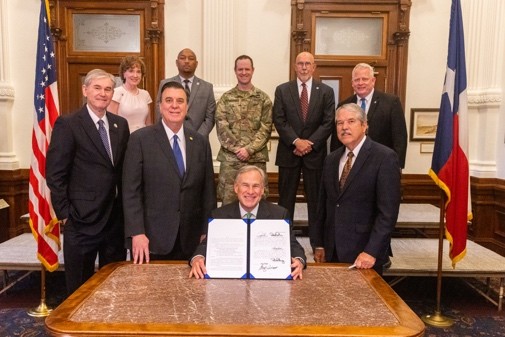
The Texas Legislature created GCPD in 2021 through Senate Bill 1160, establishing a special-purpose district for Chambers, Galveston, Harris, Jefferson and Orange counties. Through that legislation, GCPD became the local public entity authorized to coordinate funding and serve as the non-federal sponsor for major coastal protection projects across the upper Texas Gulf Coast.
The legislation followed years of federal-state planning through the Coastal Texas feasibility study, which identified the need for large-scale coastal storm risk reduction and ecosystem restoration along the Texas coast. Congress authorized the Coastal Texas Project in 2022.
In 2023, GCPD signed an interim partnership agreement with the U.S. Army Corps of Engineers to support project work and future cost-share obligations.
Where We Operate
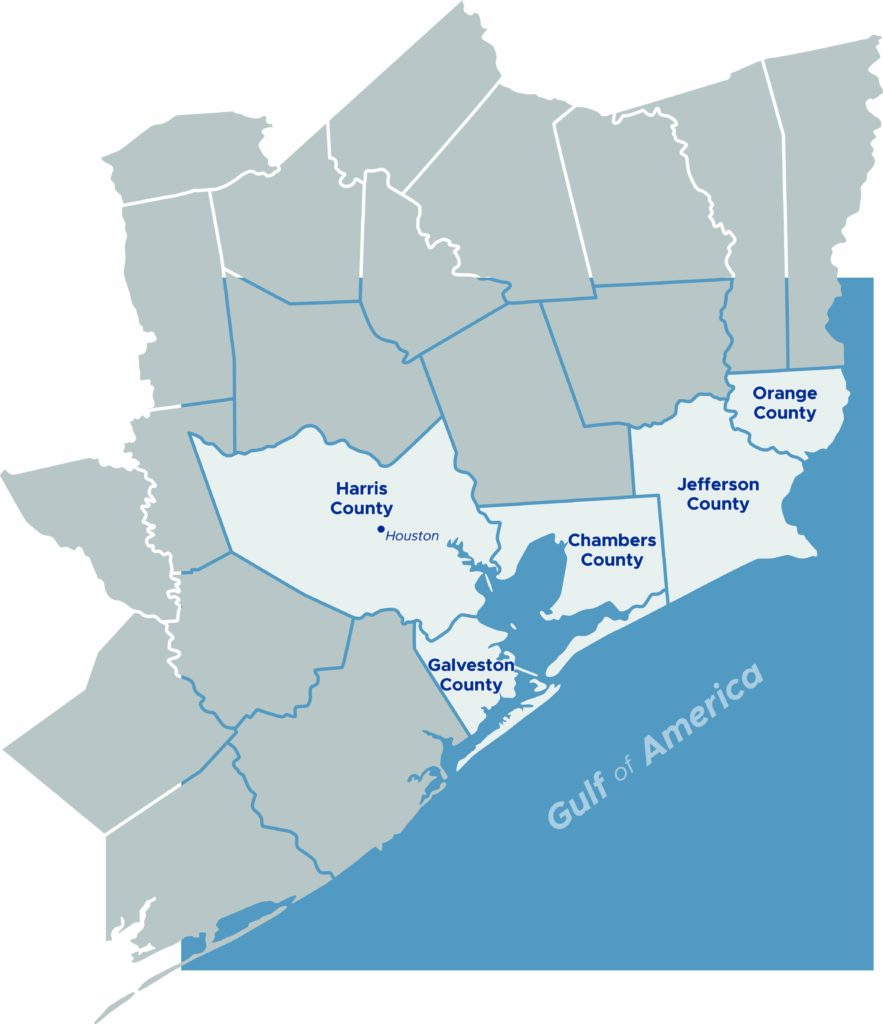
GCPD covers a stretch of the upper Texas Gulf Coast where an extraordinary share of national economic and energy infrastructure is concentrated. In a low-lying coastal area, that concentration makes hurricane-driven storm surge a serious risk to communities, industry and the wider economy.
GCPD’s administrative offices are located in the Clear Lake Area of Greater Houston between Harris County and Galveston County. Contact Us.
Five Counties, One Mission
Our territory spans Chambers, Galveston, Harris, Jefferson, and Orange counties. Together, they form a connected coastal region that includes barrier islands, bayside communities, inland population centers, and major transportation routes. The coastline is home to major ports of entry, the nation’s largest concentration of petrochemical facilities, and millions of residents.
Protecting 5,220 Square Miles of the Upper Texas Gulf Coast
GCPD is charged with safeguarding approximately 5,220 square miles along the upper Texas Gulf Coast. Within that territory, we coordinate with local governments, state agencies and our partners at USACE and the Texas General Land Office (GLO) to advance coastal protection at a scale that no single county or municipality could achieve alone.
How GCPD Is Governed
Oversight of the GCPD’s activities is accomplished through multiple different means, at multiple levels of government, to ensure the GCPD is executing its duties in accordance with its Enabling Legislation, as amended, and for the benefit of the people, businesses, and communities it represents.
Furthermore, the GCPD is required to comply with the Texas Open Meetings Act, the Texas Public Information Act, all applicable laws relating to local government ethics, conflicts of interest, and public disclosures, all applicable laws relating to local government contracting, and the Texas Public Funds Investment Act and the Texas Public Funds Collateral Act.
- Texas Commission on Environmental Quality (TCEQ): The GCPD is a district subject to the continuing supervision of the Texas Commission on Environmental Quality (the “TCEQ”) pursuant to Section 5.013, Water Code, and 30 Texas Administrative Code Section 293.3.
- Appointed Board of Directors: GCPD is governed by an eleven-member Board of Directors. The commissioners courts of Chambers County, Galveston County, Harris County, Jefferson County, and Orange County each shall appoint one director. The Governor, with the advice and consent of the Senate, shall appoint six directors as follows: two directors to represent Harris County, in addition to the member appointed by the Harris County Commissioners Court; one director to represent a municipality in the District; one director to represent ports; one director to represent industry, and one director to represent environmental concerns.
- Annual Report: GCPD must prepare and annually submit a report to the Texas Legislature, the Legislative Budget Board, the Texas General Land Office, and the commissioners court of each county in which the District is located. The report must 1) describe the District’s financial condition and operations during the preceding year, 2) propose a budget for the following year, and 3) describe generally the work proposed for the following year.
- Legislative Hearings: The District has, from time to time, been asked to participate in or provide information for interim or legislative hearings. In the past years, the Executive Director, other GCPD staff, and members of the Board of Directors have presented testimony or responded to questions from various House and Senate committees.
- Texas General Land Office (GLO): Funds appropriated by the Texas Legislature for GCPD are administered through the GLO to provide oversight of and coordination with the GCPD. In order to access those funds, GCPD has entered into Local Cooperation Agreements with the GLO.
- Sunset Commission: As part of its Enabling Legislation, the District is subject to review under Chapter 325, Government Code (Texas Sunset Act), but may not be abolished under that chapter.
Our Board of Directors
GCPD is governed by an 11-member board. Five directors are appointed by the elected county governments of Chambers, Galveston, Harris, Jefferson and Orange counties. The governor appoints the remaining six directors, with approval from the Texas Senate, to bring additional regional perspectives from Harris County, local government, ports, industry and environmental interests. Board members serve staggered four-year terms and are not compensated for their service.
To see current members and appointment details, visit our Board of Directors page.
Our Partners: USACE and the Texas General Land Office (GLO)
GCPD’s governance structure supports close coordination with our federal and state partners.
USACE leads the federal project delivery process, including engineering, environmental review and construction planning. As the non-federal sponsor, we support that process through funding coordination, design support, regulatory coordination and long-term planning.
The Texas General Land Office (GLO) serves as a state partner and co-non-federal sponsor on certain elements of the Coastal Texas Project.
We also coordinate with local drainage partners, including Jefferson County Drainage District No. 7 and Orange County Drainage District, on work connected to the Sabine Pass to Galveston Bay Project.
Learn More About GCPD
To learn more about our mission, leadership and current projects, explore the Coastal Texas Project or contact us with questions.
Frequently Asked Questions About GCPD
What does GCPD stand for?
GCPD stands for Gulf Coast Protection District. We are a special-purpose district created to support coastal protection across the upper Texas Gulf Coast.
Is GCPD a government agency?
GCPD is a special-purpose district created under Texas law. In practical terms, that means we are a public entity with specific responsibilities tied to coastal protection, project coordination and funding support for authorized coastal resilience projects.
Is GCPD the same as the Coastal Texas Project?
GCPD is the non-federal sponsor for major elements of the Coastal Texas Project. The Coastal Texas Project is the largest coastal protection effort in U.S. history led by USACE in partnership with GCPD and the Texas General Land Office.
How is GCPD funded?
GCPD’s funding comes through public funding mechanisms authorized by Texas law, including the authority to receive and issue funds, impose taxes or fees, and issue bonds for eligible purposes.
To date, the State of Texas has committed $950 million toward GCPD’s projects. Congress has appropriated $6.75 million for Coastal Texas Project in FY26 Budget, proposes $10.6 million in the FY27 House Energy & Water Development Appropriations bill, and the Trump Administration has officially identified Coastal Texas Project for inclusion in the President’s Budget FY27.
What coastal protection projects does GCPD help advance?
GCPD helps advance two major coastal protection projects: the Coastal Texas Project and the Sabine Pass to Galveston Bay Project. These projects are designed to reduce coastal storm risk and strengthen long-term protection across the upper Texas Gulf Coast.
What counties does GCPD cover?
Chambers, Galveston, Harris, Jefferson, Orange
When was GCPD created?
Charged with safeguarding approximately 5,220 square miles along the upper Texas coast, Gulf Coast Protection District is a special-purpose district established in 2021 by the 87th Texas Legislature through Senate Bill 1160.
