
You might know us better as the “Ike Dike” project. Either way, last week’s mention of the Coastal Texas Project – the largest coastal protection project in U.S. history – during the U.S. Senate Committee on Environment & Public Works hearing underscores the national importance of protecting our Gulf Coast. As stewards of this transformative initiative, the Gulf Coast Protection District is proud to be leading efforts to safeguard our communities, economy, and ecosystems from the growing threat of coastal storms.
The Senate’s attention to the Coastal Texas Project validates years of planning and collaboration between federal and state agencies. It signals momentum and growing bipartisan support for coastal resilience.
What is the Coastal Texas Project?
In an era of superlatives, the Greater Houston region is quite literally existing as one. We manufacture 80 percent of the nation’s military-grade fuel, refine 30 percent of the nation’s gasoline, and hold 30 percent of the nation’s strategic petroleum reserve. Port Houston is the largest port for waterborne cargo in the nation overall and houses the largest container terminals in the Gulf of America. The Houston Ship Channel generates nearly $1 trillion in economic benefits for the U.S. each year and creates about 3.5 million jobs.
While we are proud to contribute to our nation’s national and economic security, we consistently face challenges protecting the world’s largest petrochemical complex from severe weather threats. Houston has faced a dozen hurricanes in past twenty years.
The Coastal Texas Project is a multi-billion-dollar, multi-decade initiative designed to reduce storm surge risk and restore critical ecosystems across the Texas coast.
This mammoth project protects not only homes and lives but also vital infrastructure, including energy, petrochemical, and defense facilities that serve the entire nation. Through bold, locally driven action, we are building coastal protection that delivers national impact. Texas is taking action to protect its coast. In fact, the state has already appropriated nearly $1 billion to fund protection efforts.
A History of Storms
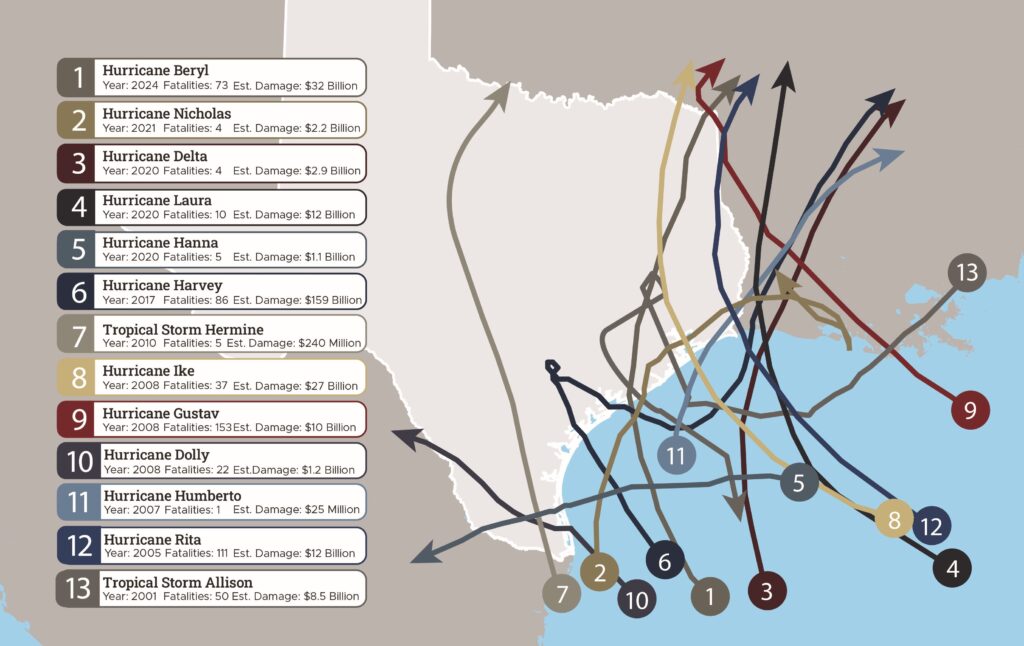
The threats are real. Whether a severe weather event achieves a direct hit crippling oil and gas production and causing an ecological disaster never before seen or risking lives and economic vitality of millions of Americans, the potential consequences – estimated to be more than $100 billion – are not good for the fourth largest city in the nation.
The Galveston Bay Storm Surge Barrier System, the largest of its kind in the world, will be designed to shield millions of residents and billions of dollars in infrastructure from catastrophic flooding. This isn’t just about protecting property—it’s about preserving livelihoods, maintaining energy security, and ensuring that our children inherit a coast that is both beautiful and safe.
We’ve seen the devastation that hurricanes like Milton, Harvey, and Katrina can bring. These storms are no longer rare events—they are becoming the norm. Without proactive measures, the cost of inaction will be measured not only in dollars but in lives. That’s why the Gulf Coast Protection District is working tirelessly with our partners to speed up planning and implementation.
We are putting our mission into action by advancing a world-class project aimed at protecting the upper Texas coast from storm surge and flooding. The Gulf Coast Protection District is a model for how states can lead the way in building long-term coastal resilience. Local action is key to disaster mitigation. When communities lead, solutions meet real needs.
Let’s Turn Mission into Action
We urge residents, business leaders, and elected officials to stay engaged, advocate for federal funding, and support the Coastal Texas Project to make Texas the most resilient coast in the world.
Washington should join Texas in safeguarding life, property, and economic vitality by building the largest U.S. Army Corps of Engineers project in history – and protect the world’s largest petrochemical complex.
